
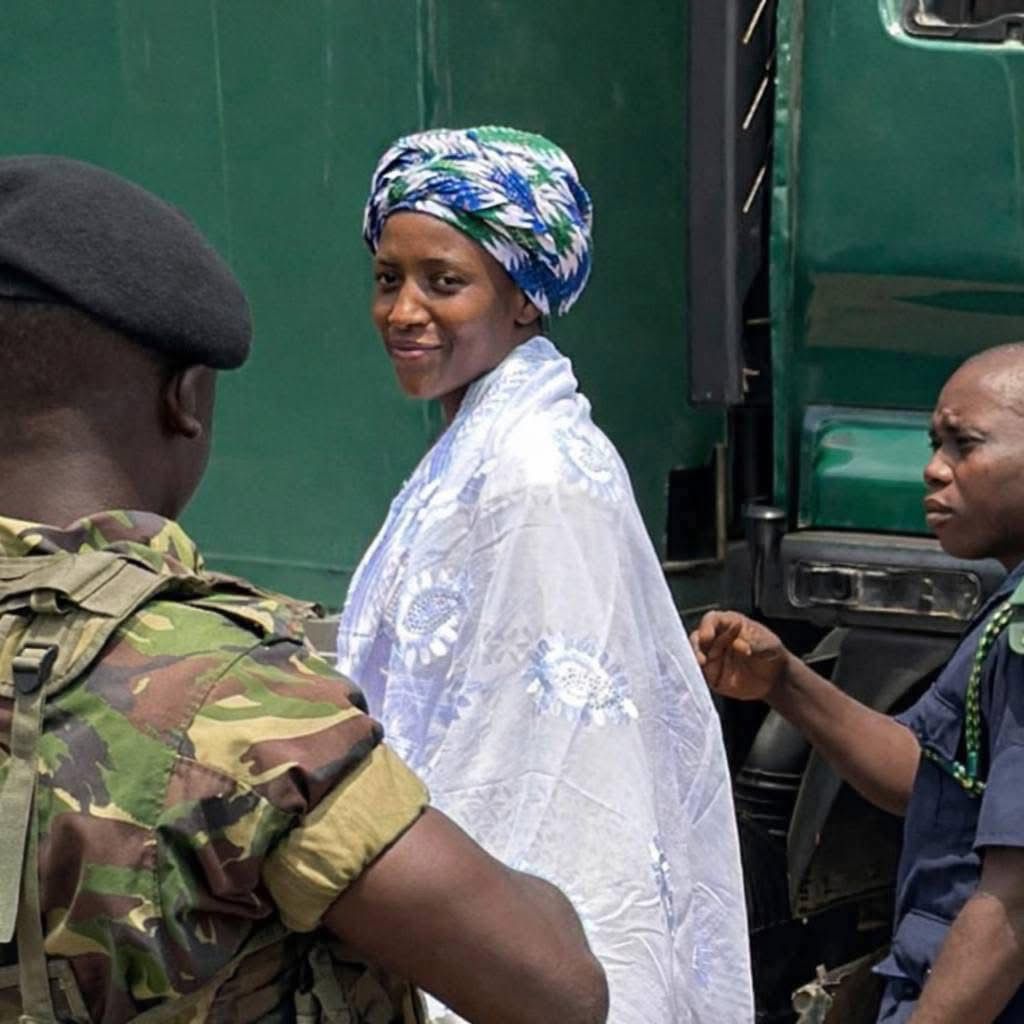
The unsurprising conviction of Zainab Sheriff came this week after what turned out to be a speedy trial. The court found her guilty on both counts of using threatening language and incitement. She is likely to spend the next four years of her life in jail. While we have shared our thoughts in the past about the singer, model, and activist’s brush with the authorities, we revisit the issue here, drawing out elements that help make sense of what has just played out and what it means for everyone: you, you, you, all of us.
Let’s get into it. Di law, na di law, we’ve been told. Yes, the law is the law. However, the law does not exist in isolation. For better or worse, those who make and interpret laws eventually bring their own influence to bear on how those laws are applied and enforced. Many commentators have drawn comparisons with the case of Abdul Kadiru Kaikai, a ruling party member who threatened to wage war on Sierra Leone. The authorities chose to caution him and let him go, while his party condemned him. He apologised, and that was the end of the matter. Yet, Mr Kaikai’s statement could arguably amount to subversion or even treason.
Contrast this with Zainab’s remarks at an APC rally, for which the party itself had already been fined by the Political Parties Regulation Commission (PPRC). This contrast illustrates how enforcement authorities often apply selective lenses: deciding what constitutes a prosecutable offence and what merely warrants a caution. The same police and state prosecutors who charged and prosecuted Ms. Sheriff with threatening language chose not to press charges against a ruling party member who threatened war. How, then, can citizens be convinced that Zainab’s trial was purely about public order and not the targeting of dissenting voices aligned with the opposition?
This well-worn comparison serves two purposes. First, it shows that law enforcement actors exercise discretion in deciding whether to press charges and for what reasons. Zainab, too, could have been cautioned and released. As we noted previously, she may have become a handful for the authorities, prompting a decision to deal with her decisively. Second, it reinforces the perception that punishment often depends on where one stands on the political divide.
Beyond concerns about selective enforcement and the silencing of dissent, the speed of the trial also deserves both commendation and scrutiny. Some argue this is not a political matter. This claim may or may not hold, depending on perspective. However, in a judiciary burdened by an enormous backlog of cases, many of which have dragged on for months or years, the swift conclusion of this trial is remarkable.
We do not question the court’s efficiency; after all, justice delayed is denied. But what would be more meaningful is for this efficiency to extend to those currently behind bars without political visibility or influence, those whose cases lack the profile of Zainab Sheriff. If the system can move this quickly, it should do so consistently, particularly for the many unknown individuals languishing in prisons across the country.
Zainab’s conviction is bad for Sierra Leone. In this day and age, we should not be convicting and jailing people for what they say, especially when enforcement appears selective. The situation was entirely avoidable. Zainab’s statements carry little or no weight; she holds no formal authority within any political party. With all respect due her for her personal achievements, her words are of little concern and do not warrant the full force of the State. This is why many argue the case goes beyond Zainab Sheriff. It appears to send a message. A warning to other critical voices who dare to speak freely. The untamed voices. Otherwise, it is difficult to understand why the State would entangle itself in such an unnecessary controversy. Once again, those in power have failed to show magnanimity and become the bigger people, a matter that costs them absolutely nothing. They get offended by the slightest provocation. People in and with power certainly should have much thicker skin. Well, clearly not.
Political parties, particularly those in power, often act with the confidence that they can get away with anything. They accumulate enemies, sometimes needlessly, and operate in an environment where fear reigns. Critical voices are diminishing, except for those shielded by political institutions. Even that is not a guarantee. Since the events of August 10 2022, protest has become almost unthinkable. Even verbal dissent, as seen in Zainab’s case, now carries a clear and bold warning. Yet political actors often forget a simple truth: how you pred you bed, na so you go ledon de.