A new World Bank report reveals troubling insights into the growing debt burden faced by low-income countries, including Sierra Leone. According to the 2025 International Debt Report released this week, developing countries have effectively become net payers rather than net borrowers.
In what the report describes as the largest net outflow in more than 50 years, “US$741 billion more flowed out of developing economies in debt repayments than flowed in” between 2022 and 2024.
While this pattern might suggest responsible debt management, experts warn that small economies like Sierra Leone, which depend heavily on imports, will have very limited room for manoeuvre, sacrificing investment in key services and development to debt servicing.
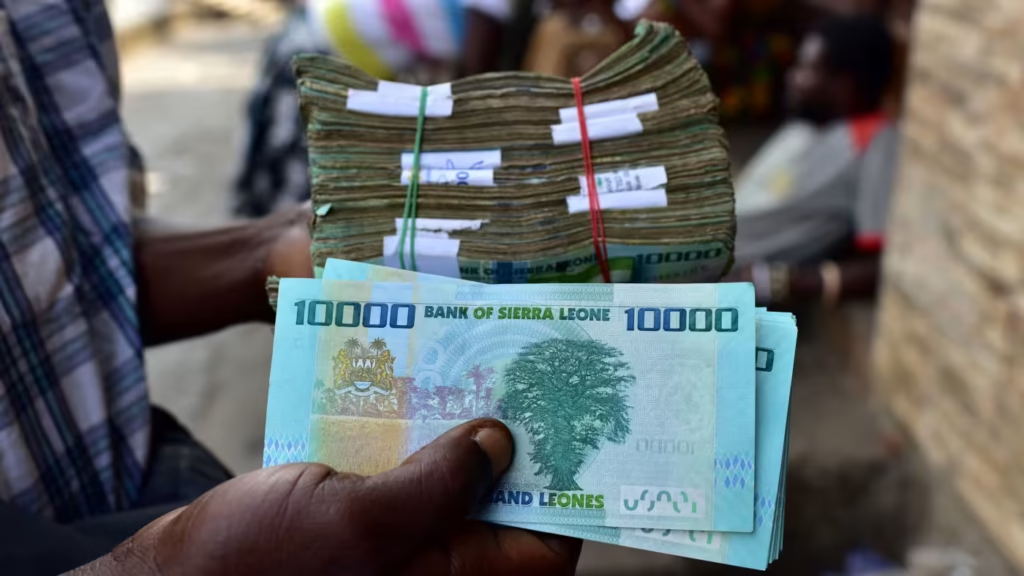
According to the 2026 budget presented to Parliament last week by Minister of Finance Ahmed Fantamadi Bangura, the government is projected to spend NLe 8.6 billion (4.6% of GDP) on debt service in 2026. Interest payments alone include NLe 275.8 million on foreign debt and NLe 6.4 billion on domestic debt. This is more than the projected spending on key social services like health and education, which get an allocation of NLe 1.4 billion and 1.3 billion, respectively.
Like many low-income countries, Sierra Leone’s external debt is dominated by obligations to multilateral creditors such as the World Bank and the International Monetary Fund. Multilateral sources now constitute 78% of Sierra Leone’s public and publicly guaranteed external debt, serving as both a lifeline and a source of vulnerability.
There has also been a widespread shift in domestic debt among low-income countries. “Among the 86 for which domestic debt data are available, more than half—50 in all—saw their domestic government debt grow faster than external government debt,” the report observed. Sierra Leone is one of them, with NLe 6.4 billion earmarked for domestic interest payments in 2026.
According to the International Debt Report, this surge in domestic borrowing comes at the expense of the private sector. “Local commercial banks load up on government bonds when they should be lending to the private sector,” the report says. This diverts capital away from farmers, entrepreneurs and small businesses, reducing access to credit and slowing private-sector growth.
The report shows Sierra Leone’s total external debt at US$2.33 billion, slightly lower than last year, an indication of relative stability, but not necessarily of reduced vulnerability.
The country’s persistent debt stress reflects deeper structural weaknesses, including import dependency and weak revenue mobilisation, experts say. As the World Bank’s Country Economic Memorandum observes, “only 2 percent of Sierra Leonean firms export, and the composition of exports is still dominated by resource-based products, with extractives accounting for over half of goods exports.” Meanwhile, fuel, rice, textiles, medicines and other essential goods continue to be heavily imported and paid for in foreign exchange. Although rice importation is said to have decreased by 16%, it still costs the country around US$200 million in 2024.
Together, the figures highlighted in the International Debt Report and Sierra Leone’s 2026 budget show a story of debt stress that threatens development prospects.