
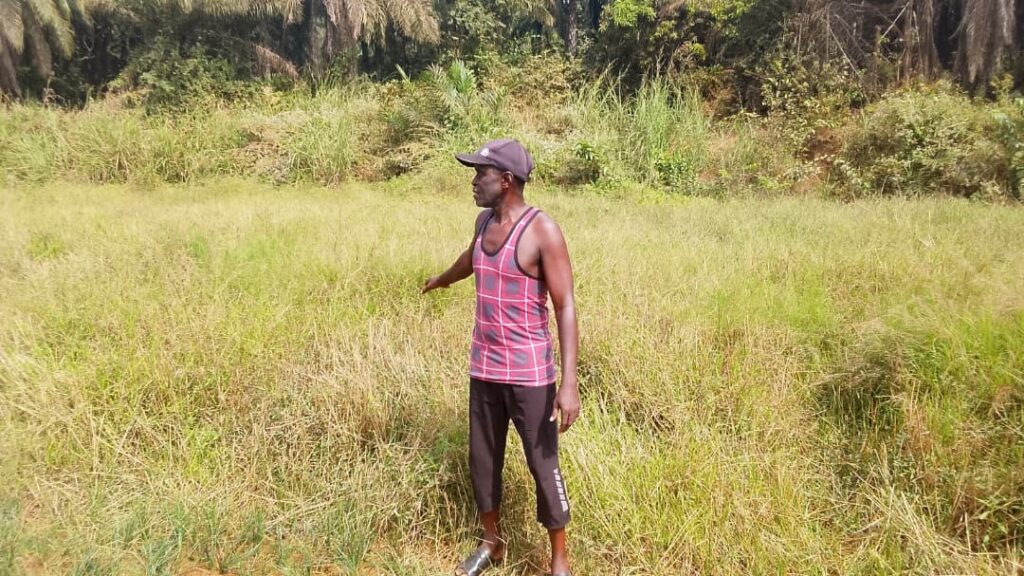
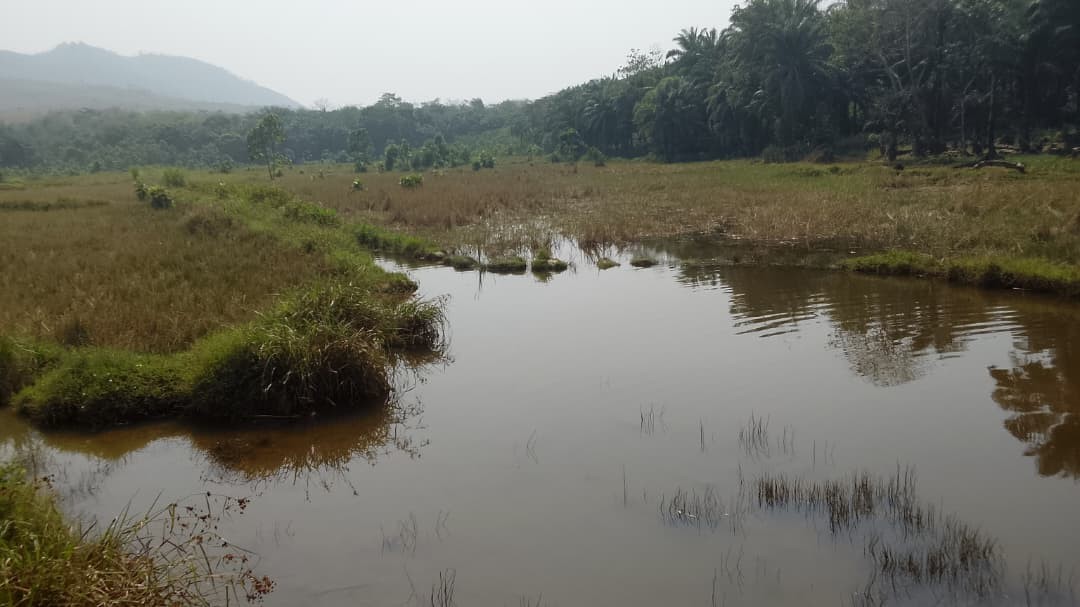
Under a hot, burning February sun, a group of farmers are hard at work, mounding in a swamp, in preparation for transplantation.
In Rochen Kamandao, a village five miles from Mile 91 in the northern Tonkolili district, agriculture is an all-year-round activity, thanks to the innovativeness of some farmers who have taken advantage of a soil that allows for both upland and lowland farming.
Among the mound builders is Mohamed Gibrill Thullah. He has done this for over a decade, but this particular activity is very crucial, coming after a disastrous performance of his rice in the just ended upland cropping season.
Mohamed is one of a dozen farmers hit by a crippling low yield caused by a waterlogging incident they blamed on a mining company operation. The Chinese owned Tuolei Stone (SL) Limited operates a stone quarry in neighbouring Gbonkor Lal Village, where reconstruction of a collapsed bridge led to the waterlogging.
“This is my worst harvest ever,” Mohamed tells Engage Salone. “The water was too much and we couldn’t work as we were used to.”
Rochen Kamandao, a predominantly agrarian community, is in Yoni Mamaila Chiefdom. Over 80 percent of the village’s roughly 1000 population engages in agriculture, mainly subsistence farming. Some of them also do petty trading.
Like many farmers here, Mohamed grows rice, both upland and lowland, in the rainy season, and vegetables – pepper, African garden egg, tomato – during the dry season. These short-term crops guarantee farmers cash almost year-round.
But this year, things turned out badly for many of them. For James T. Kamara, it was a near-total disaster.
“This year’s planting season was a great loss; all my crops got destroyed. The pepper got rotten and the groundnut didn’t grow as it should,” he explains.
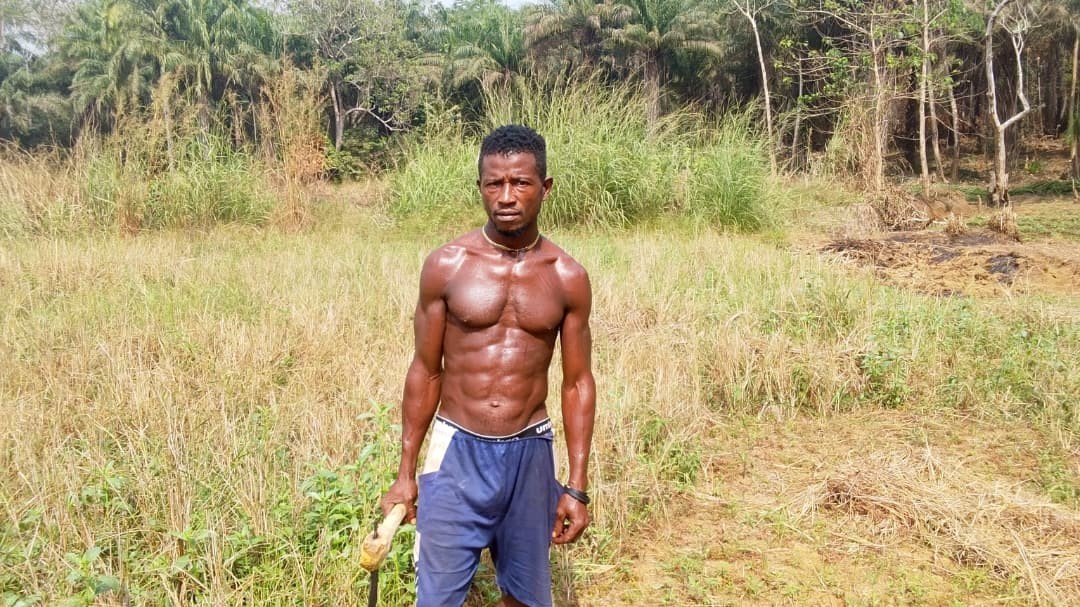
Tuolei specializes in extracting, processing, and supplying high-quality stone for large-scale construction projects, according to information obtained from online media reports. Its operations entail the movement of heavy-duty vehicles transporting its products from its quarry up the hill in Gbonkor Lal to the capital, Freetown, for onward shipment overseas. The impact of the heavy duty vehicle movement over the bridge is believed to have led to its collapse last year, according to the affected farmers and local authorities.
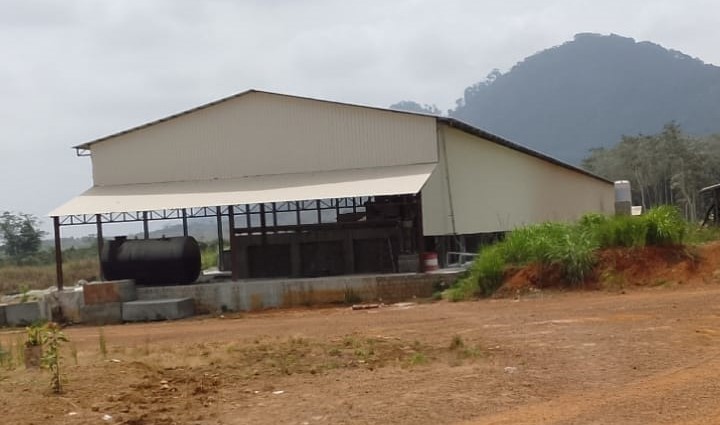
After months of complaints and threats of protest, the company eventually reconstructed the bridge, according to the villagers. But even before the inauguration, the problem stemming from the construction work led to waterlogging.
Abdulai Sesay, a councillor representing the community in the Tonkolili District Council, says a boulder used as part of construction work blocked the waterway. When it rains, the water settles on the swamp, he explains.
“Most of the residents with farms in the swamp couldn’t plant their crops as they were used to, because even with the smallest rain the water settles,” says Councilor Sesay.
About 10 farms are located in the affected swamp area, according to the villagers.
When he is not farming, Mohamed teaches in the village’s primary school. But the father of four says farming is his main source of income, with the swamp rice accounting for the largest chunk of his yearly income.
Unlike many of his colleagues, Mohamed relies heavily on paid labour due to ill health, making the proceeds from his crops crucial to maintaining the cultivation cycle. Five ‘pans’ of seeds usually yield six bags of rice, he says.
“This year, I just got three bags. The rice didn’t do well. Those three bags won’t take me far. When I had a good yield, I could sell and pay for other needs. But these three bags aren’t enough. I can’t sell them,” he stresses.
Mohamed is also wondering where seeds for the next rice planting season will come from. He hopes the government can come to his aid.
But his immediate concern is ensuring his kids’ schooling this academic year. The elder child was among those who sat the 2025 West African Senior Secondary School Certificate Examination, and he was to go to university. Mohamed says they had to put that on hold. The second child began Senior Secondary School this year. His prospect of continuing is low, he says, citing a lack of resources to provide the necessary support. The two younger ones are in primary school.
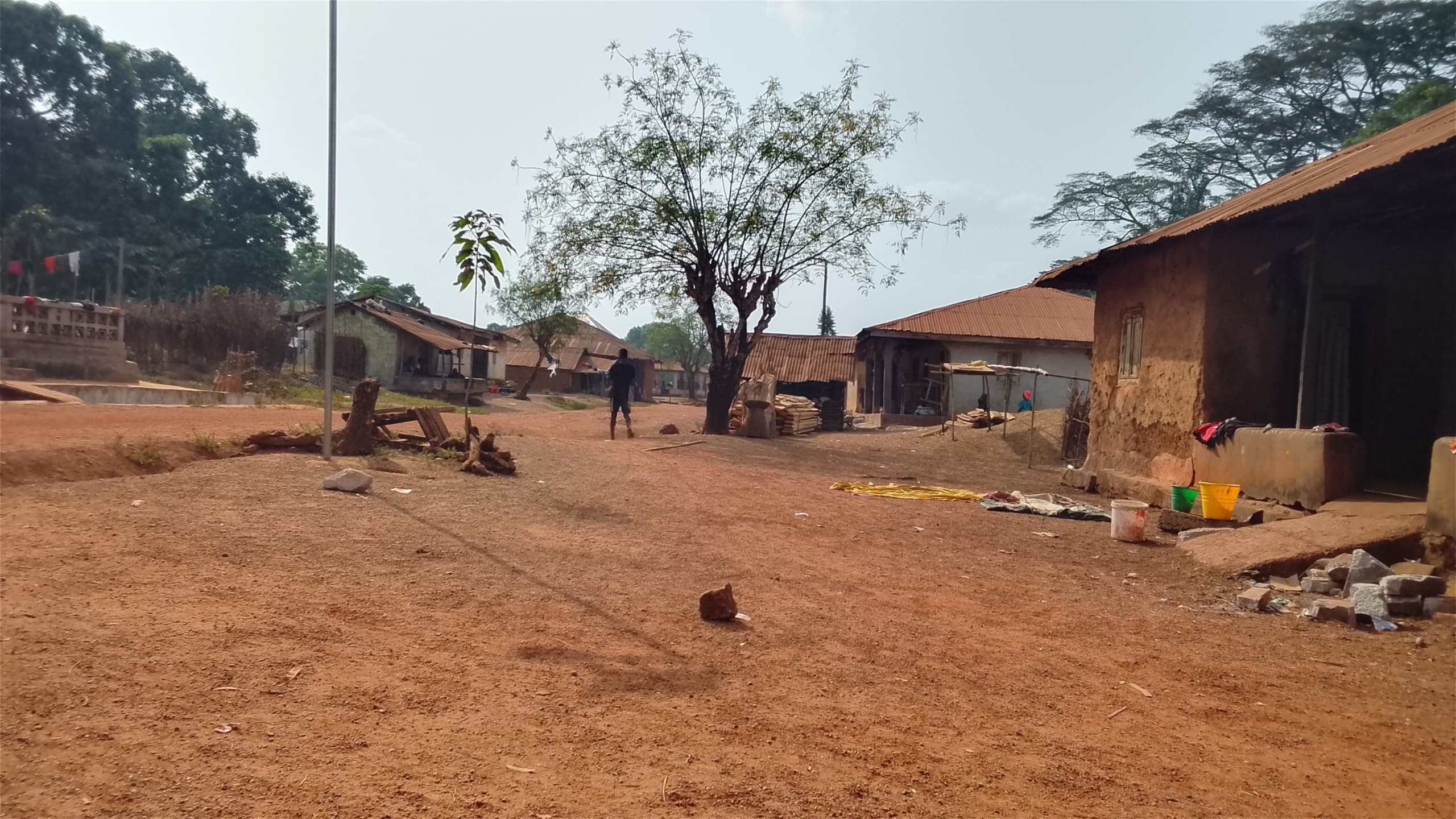
The stories are the same for all the affected farmers in Rochen Kamandao.
Adama Kargbo, a widow and mother of five children, used to have at least six bags of rice after every harvest from her farm. This year, she got just three bags.
“I couldn’t even complete the harvest because of the poor quality of the crops,” she says.
Kargbo says her children haven’t returned to school since the academic year began in September because she couldn’t afford their school supplies. They are all in primary school. The Sierra Leone government’s free education programme that targets primary and secondary school going children only caters for school fees, placing the responsibility to provide learning materials such as books, and stationery, as well as uniforms on parents.
In Rochen Kamandao and many communities here in Tonkolili, farming is a lifeline.
“I have other family members I am taking care of,” says Kargbo, emphasising the impact of the situation on her life.
Tonkolili is one of Sierra Leone’s districts most endowed with mineral resources, yet it’s also a place where poverty and deprivation are widespread. Poverty is largely a consequence of these very mineral resources, as the situation in Rochen Kamandao shows. The district hosts some of the most lucrative mining opportunities in the country, with iron ore as its primary export. It is renowned for hosting one of the world’s largest iron ore deposits. Other minerals in the region include gold, coltan and chromium.
Over the last few decades, Tonkolili has hosted numerous multinational companies, including British-owned. But at present, large-scale operations here are dominated by Chinese investment, some with local joint ventures. All of these companies – past and present – have left, or continue to leave, a dark environmental legacy in host communities, including extensive deforestation, land destruction, and significant water pollution, as documented in numerous local and international reports.
An October 2025 brief by the US think tank, The Atlantic Council, on the impact of Chinese mining on eleven West African countries, explored how individuals, corporations, and state actors were increasingly involved in both legal and illegal mineral mining operations across the region. Sierra Leone was one of the countries featured.
“While some Chinese operations have created jobs and infrastructure in mining communities, their negative impacts on water resources, forests and biodiversity, livelihoods, health, and food security across West Africa have been profound,” it says, blaming the failure of national or regional policies and enforcement mechanisms to address the social and environmental impacts of mining in the region.
Local observers say the regulatory shortfalls have left the miners unaccountable, leaving communities struggling to make a decent living.
Social and environmental activist Gibrill Amid Sesay, says the centralised mode of operation of regulatory institutions responsible for the mining sector leaves host communities vulnerable to abuse with impunity in the hands of powerful investors.
“We have EPA (Environmental Protection Agency) and the Environment Ministry, but communities lack representation in these institutions. They are (based) in Freetown or Makeni and only come when there is a problem. They give reactive responses when we need real time responses,” he says.
Amid, a resident of Mile 91, founded the Initiative for Rural Development Organization (IRDO) Sierra Leone in 2020, on the backdrop of the global economic crisis triggered by the Covid-19 pandemic. His goal was to encourage young people to engage in farming, he says.
IRDO provides mentorship for the youngsters and connects them with farmers through community engagement and outreach.
These days, Amid shares his time between his activism and full time job at the Central University as Director of Quality Assurance and International Affairs. He stresses that mining has had far reaching negative implications on life in Tonkolili, noting that for him, the impact on agriculture has been the most impacting.
“Agriculture has experienced a very huge setback in the district,” he says, noting that an unhealthy focus on mining with a get-rich-quick mentality across the district created a “labour vacuum” in the farms, as well as environmental degradation.
The situation in Rochen Kamandao perfectly illustrates this reality. According to the villagers, Tuolei’s operation is also responsible for the pollution of the only water source for a total of eight communities along a major stream from Foindu, right up at Gbonko Lal, to Rochin Kamandao. They say wastewater from the mining site contaminates the stream.
“Whenever it rains, all the waters along this part get polluted,” says Councilor Sesay. “They change color. None of it is fit for any purpose, whether for drinking, cooking or laundering. Even for bathing, people don’t dare.”
Tuolei reportedly attempted a quick fix by digging a pit to hold the polluted water, but the villagers say when it rains heavily, the waste water escapes into the stream. Councilor Sesay is worried that with the coming dry season, inhabitants of the affected villages may face difficulty accessing clean water if this issue isn’t addressed. He is suggesting the construction of boreholes.
The management of Tuolei recently changed hands, and its new Sierra Leonean Site Manager, Gibrill Sesay, acknowledged community concerns but says they have been working with stakeholders to address them. According to him, the boulder that caused the waterlogging was the result of poor work done by the villagers themselves. He explains that after receiving complaints about the broken bridge, they offered the community two options: either the company fixes it, or the villagers themselves oversee the reconstruction work. He says they opted for the latter.
Sesay also says they built two dams to address water pollution, and he believes that has been addressed, although the Councillor insists the problem still persists.
Rochen Kamandao is home to a rival Chinese stone mining company, Dong Tai. Miro Forestry, a multinational timber production company, also operates in the area. Sesay, a manager at Tuolei believes all of these companies contribute to the environmental issues facing the neighbouring communities, pointing out that Tuolei is always unfairly targeted due to rivalry between the two neighbouring villages on one hand and between the two stone miners on the other hand. Manager Sesay claims that the people of Rochen Kamandao, because of this rivalry, prevented his company from using an alternative route that he says could have saved them from the hurdles from the heavy duty vehicles.
The impact of Miro’s operation epitomizes the problems the people of Tonkolili are dealing with in the hands of foreign investors. Campaigners say between 60 and 70 percent of land suitable for agriculture in the Mile 91 axis is owned by this company that is managed by a UK-incorporated parent company.
“Local farmers are restricted from accessing their farms and the bushes for basic needs like firewood,” says Amid.
“They can’t plant vegetables. They are forced to rely on imported goods for survival.”
As per Sierra Leone’s Mines and Minerals Act 2022, the Ministry of Mines and Mineral Resources (MMMR), through the National Minerals Agency (NMA), licenses all mining operations, including for quarrying or stone mining projects. Yet the NMA’s Northeastern regional office has no records of Tuolei Stone (SL) Limited. Regional Manager Isaac Kallon, based in Makeni, referred Engage Salone to the Ministry of Works when contacted about Tuolei’s registration status.
The Ministry of Works didn’t respond to an email request regarding Tuolei’s registration status.
According to the Mines and Minerals Act 2022, quarrying falls under smallscale or artisanal mining and such licenses are issued through the Mining Cadastre Office within the NMA. Tuolei is not listed anywhere in the Online Mining Cadastre either.
However, EPA appears to have a record of the company’s existence, although this is also not made public. EPASL’s regional manager, Sheku Sillah, who is also based in Makeni, confirmed that his office received complaints from the people of Rochen Kamandao, though not about water pollution.
“I have not received any complaint about water pollution. The issues raised by stakeholders in Rochen Kamanda were air pollution and house cracks caused by heavy duty vehicles,” he says when contacted by Engage Salone.
But Councillor Sesay insists that he personally informed the EPASL regional officers during a visit to the village earlier about the water pollution and that they promised to visit in March 2026 when they intended to receive a formal complaint from him.
EPASL is also responsible for approving the Environmental Impact Assessment (EIA), which every applicant for mining rights must obtain. The EIA identifies risks—including noise, air pollution, and land degradation—and develops mitigation strategies to ensure compliance.
The Tuolei Site Manager couldn’t tell whether his company had an EIA, though he recalls that a document along those lines was presented on the company’s behalf by the EPA regional manager.
Mr Sillah declined to respond to our request for further clarification on this and other issues regarding Tuolei’s operations, insisting that such requests should be addressed to the head office in Freetown. The agency’s Executive Director, Dr Abu Bakarr Massaquoi, acknowledged receipt of our email request two weeks after it was sent, yet he didn’t provide any information regarding the request. Instead, he requested GPS coordinates and other technical information, which falls outside of the scope of our inquiry. A second email request for clarification on the company’s environmental impact assessment went unanswered as of the time of publication.
The Directorate of Community Affairs at NMA also failed to respond to queries via WhatsApp about Tuolei’s registration status, even after the Director, Ibrahim Satti Kamara, promised to do so when contacted by phone.
Amid, the activist argues that to ensure institutions adhere to regulatory provisions, they must have a unit that is dedicated to monitoring their activities in real time. He also wants to see “collective efforts” of local stakeholders to hold duty bearers accountable.
“People should be held responsible for the public offices they hold,” he says. “The environmental impact of these mining companies can have a long term effect even beyond our generation. Environmental issues affect everyone; it doesn’t matter your political leaning, tribe, or whether you are a farmer or not. If we are not protecting the farmers, it means we are not protecting ourselves.”
Mohamed and other affected farmers are concerned about their livelihoods in the coming months due to poor yields from this cropping season and the environmental challenges they face.
“We want the government to know that this is what happens as a result of the activities of these companies mining here. We hope the government can do something about it,” says Mohamed.
For Section Chief Mohamed Fullah, the immediate concern is the effects of low crop yields on families and the prospects that lie ahead amid a lack of signs of a solution.
“We have no idea what kind of rain will come; it could be worse than before. I want us to fix this issue once and for all,” he says.
Additional reporting by Kemo Cham in Freetown and Abdul Jalloh in Makeni.